
Understanding Pad Mounted Transformer Standards: A Comparative Guide to IEEE, ANSI, IEC, and North American vs. European Compliance for Global Procurement
Navigating the Global Maze of Pad Mounted Transformer Standards
For engineers, procurement specialists, and utility planners sourcing pad mounted transformers, understanding the complex web of international standards is not just academic—it's a critical business necessity. A 500kva pad mount transformer destined for a solar farm in Texas must meet different regulatory benchmarks than an identical unit powering a residential district in Germany. This divergence stems from two primary, and often conflicting, sets of standards: the North American framework led by IEEE and ANSI, and the international IEC standards prevalent in Europe and much of the world. This guide provides a detailed comparison, helping you make informed decisions for your next project, whether it requires a UL listed pad mounted transformer or an IEC-compliant unit.
Key Takeaway:
Choosing the correct standard is the first step in specifying a reliable pad mounted distribution transformer. It dictates design, safety, testing, and ultimately, project approval and longevity.
Part 1: The North American Powerhouse: IEEE & ANSI Standards
The North American market, including the USA and Canada, is governed by a robust system developed by the Institute of Electrical and Electronics Engineers (IEEE) and the American National Standards Institute (ANSI). For pad mounted transformer manufacturers, compliance with these standards is non-negotiable for market access.
Core ANSI/IEEE Standards for Pad Mounted Transformers:
- ANSI C57.12.20: This is the cornerstone for single phase pad mounted transformers and network transformers. It covers ratings, construction, and testing for units up to 500 kVA and 34.5 kV.
- ANSI C57.12.34: The equivalent standard for three phase pad mounted transformers. It applies to units with ratings from 45 kVA to 5500 kVA and voltages up to 34.5 kV.
- ANSI C57.12.90: The standard test code that defines how transformers must be tested to verify performance claims, including load loss, no-load loss, and impedance.
- ANSI C57.12.38: Specific to pad-mounted, compartmental-type, three-phase distribution transformers.
These standards emphasize ruggedness, safety (with tamper-resistant enclosures), and interoperability within the North American grid. They also work in tandem with the U.S. Department of Energy's (DOE) energy efficiency regulations (DOE 2016), which mandate minimum efficiency levels for distribution transformers, pushing manufacturers towards advanced core steel and optimized designs.
Certification bodies like Underwriters Laboratories (UL) and the Canadian Standards Association (CSA, issuing cUL certification) provide third-party validation. A UL listed pad mounted transformer or a cUL certified pad mounted transformer is a trusted passport for installation across the continent.
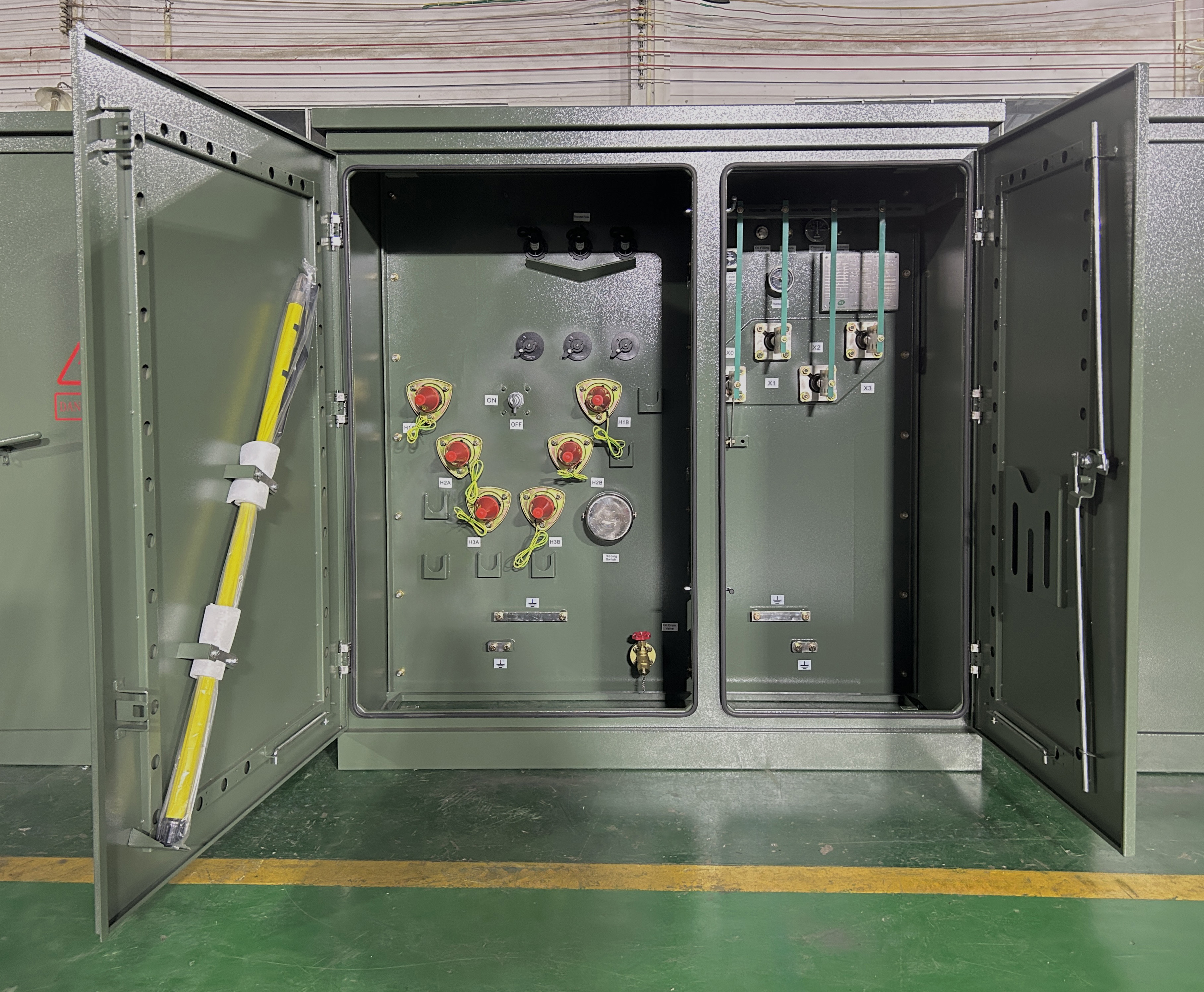
A 500kva three phase pad mounted transformer designed and tested to stringent ANSI/IEEE standards, ready for the North American utility market.
Part 2: The International Framework: IEC Standards
The International Electrotechnical Commission (IEC) sets the global benchmark, widely adopted in Europe, Asia, Africa, and Oceania. While harmonized in the EU as EN standards, the core technical philosophy differs from North American practice.
Key IEC Standards for Oil-Immersed Transformers:
- IEC 60076: This is the overarching series for power transformers. Key parts include:
- IEC 60076-1: General principles and definitions.
- IEC 60076-2: Temperature rise and cooling.
- IEC 60076-3: Insulation levels, dielectric tests, and external clearances in air.
- IEC 60076-5: Ability to withstand short-circuit currents.
- IEC 60076-11: Specific to dry-type transformers.
- IEC 61936: Covers power installations exceeding 1 kV a.c., influencing transformer installation and safety practices.
IEC standards often focus more on fundamental performance principles and testing methodologies, sometimes allowing more design flexibility than the prescriptive ANSI standards. For instance, IEC temperature rise tests are conducted under different ambient conditions. The CE marking, based on these standards, is the key to the European market.
Part 3: Head-to-Head: Key Differences Between ANSI/IEEE and IEC
Understanding these differences is crucial when sourcing from global pad mounted transformer manufacturers like Winley Electric, which must master both systems.
| Aspect | ANSI/IEEE (North America) | IEC (International/Europe) |
|---|---|---|
| Voltage & kVA Ratings | Standardized, discrete ratings (e.g., 75 kva, 150 kva, 225 kva, 500kva, 1000 kva). Common primary voltages: 12.47kV, 13.2kV, 13.8kV, 34.5kV. | More flexible, often based on R10 or R20 preferred number series. Common voltages: 11kV, 22kV, 33kV. |
| Insulation Levels (BIL) | Basic Impulse Level (BIL) is a key specification (e.g., 95kV, 125kV, 150kV). Defined in standards. | Lightning Impulse Withstand Voltage (LIWV) and Power Frequency Withstand Voltage. Values differ from BIL ratings. |
| Temperature Rise | Based on a 30°C average ambient. Common limits: 65°C/65°C (winding/oil) for oil type transformers. | Based on a 20°C average ambient. Common limits: 60K/60K (winding rise/oil rise). |
| Sound Level | NEMA ST-20 defines sound levels. Tends to be more stringent for residential areas. | Defined in IEC 60076-10. Measurement methods and limits can differ. |
| Enclosure & Safety | Highly prescriptive: tamper-proof, locked compartments, specific clearances. Critical for pad mount transformers for utility in public spaces. | Often defined by national installation codes (e.g., in the UK, Germany). May allow more variation in enclosure design. |
| Certification Mark | UL listed or cUL certified pad mounted transformer. | CE Marking (for Europe), often supported by TUV or other Notified Body assessments. |
Part 4: The Manufacturer's Perspective: Building for a Bifurcated World
Leading global manufacturers don't just choose one standard; they engineer for both. Winley Electric, a professional transformer manufacturer certified by UL and cUL, exemplifies this dual-capability approach. With factories in Shanghai and Guangdong, and R&D teams proficient in ANSI, IEEE, CSA, DOE2016, NEMA, and IEC, they can pivot production based on destination.
For a Solar Pad Mount Transformer project in Canada, Winley would design a three phase pad mounted transformer to ANSI C57.12.34 and CSA C227.4, ensuring it meets DOE 2016 efficiency rules and carries the necessary cUL certification. For a similar project in France, the same oil-immersed pad mount transformer would be engineered to IEC 60076 and relevant EN standards to achieve CE marking.
Winley Electric: A Case Study in Global Compliance
Founded in 2014, Winley Electric has built its reputation on mastering global standards. Their product range, from a compact 50 kva pad mounted transformer to a massive 3750 kva pad mounted transformer, is backed by a comprehensive certification portfolio including UL, cUL, ISO, CE, and TUV. This isn't just paperwork; it's embedded in their ISO 9001 management system, traceability protocols, and advanced testing facilities featuring lightning impulse testers.
This capability allows them to offer true customization. Whether a client needs a UL listed pad mounted transformer for a U.S. housing development, an IEC-standard unit for a Middle Eastern industrial park, or a specialized zig zag pad mounted transformer for a grounding application, Winley's engineering team can deliver a cost-effective, compliant solution. Their 24/7 technical support further ensures smooth integration, from drawing design to installation guidance.
Contact Winley Electric for your global transformer needs:
Website: https://www.winley-electric.com/
Email: steven@winley-electric.com
Tel: +86-592-5510031
Conclusion: Making the Right Choice for Your Project
The choice between ANSI/IEEE and IEC standards is fundamentally dictated by your project's location and the requirements of the local utility or regulatory body. There is no "better" standard, only the "correct" one for the application.
- For North American Projects (USA, Canada): Specify an ANSI standard pad mount transformer or IEEE standard pad mount transformer. Insist on UL listed or cUL certified products and verify DOE 2016 compliance for efficiency. Consider sizes like 167 kva, 225 kva, 750 kva, or 1500 kva based on your load.
- For European and International Projects: Specify IEC compliance, often leading to CE marking. Understand the local national deviations (country-specific norms).
- For Global Manufacturers & EPCs: Partner with suppliers like Winley Electric that have proven dual-compliance capabilities, robust quality systems (ISO 9001), and a track record of exporting to over 60 countries. This mitigates risk and ensures a smooth supply chain.
As the world's grids modernize and renewable projects like Solar Pad Mount Transformer installations proliferate, the demand for high-quality, standards-compliant pad mounted distribution transformers will only grow. By understanding these critical standards, you equip yourself to source the right equipment, ensure project safety and reliability, and navigate the global power landscape with confidence.
Have Questions or Need More Details?
Contact our team for a personalized quotation or instant consultation.
Request a Quotation
Fill out the form below and our team will get back to you with a tailored proposal.
WhatsApp Direct Chat
Prefer to chat in real-time? Message us on WhatsApp for instant assistance & quick answers.
- Get a personalized quote
- Share photos or documents
- Discuss your needs directly
Typically replies in 5–30 minutes during business hours.