Custom Pad-Mounted Transformer Sourcing for North American EPCs: A Field-Rework Prevention Playbook
.jpg)
For an EPC managing a North American distribution project, the pad-mounted transformer is a small part of the overall schedule but a frequent source of field rework. Mismatched drawings, unclear enclosure protection requirements, unverified test procedures, and late specification changes often force field crews to rework foundations, cable entries, or pad details. The practical way to prevent that is to move from generic pad mounted transformer selection to a controlled ODM workflow: drawing approval, protection-class definition, factory testing, and batch release.
Why Field Rework Happens on Pad-Mounted Transformer Projects
Field rework is usually caused by decisions that were left open until after the factory order had already been placed. The most common failure points in an EPC schedule are:
- Electrical specifications and ODM drawings not aligned at contract stage.
- Enclosure protection class, cabinet size, and tank coating requirements not defined before production.
- Cable entry, termination, and feed configuration details not confirmed in the drawing approval.
- Factory testing, witness points, and documentation requirements not agreed in advance.
- Batch quantities and delivery milestones planned without checking manufacturer capacity.
Each of these issues can be managed if the transformer is treated as an engineered item with its own approval gate. For an oil-immersed pad mount transformer, the drawing approval step is particularly important because the tank, cabinet, bushings, and protective devices are physically integrated into one unit.
Market and Standards Context for Pad-Mounted Transformers in North America
The North American market for pad mounted distribution transformers is large and continues to grow. Global Market Insights values the global pad mounted transformer market at approximately USD 22.3 billion in 2024, while Market Research Future estimates the U.S. market at USD 3.75 billion in 2024. According to OEC data, global trade for liquid dielectric transformers under 650 kVA reached USD 4.08 billion in 2024, a 22.6% increase from the prior year, with China exporting USD 511 million of that total.
Major global manufacturers include ABB, Eaton, Schneider Electric, Siemens Energy, and General Electric. This means an EPC has several sourcing routes, but the route that gives the most control over electrical and mechanical details is ODM production directly with a certified manufacturer.
Standards are also well defined. IEEE C57.12.34 covers three-phase pad-mounted distribution transformers up to 10 MVA and 34.5 kV. IEEE C57.12.28-2023 specifies enclosure integrity requirements for pad-mounted equipment. IEEE C57.12.38-2025 applies to single-phase pad-mounted transformers of 250 kVA and smaller. For North American EPCs, these standards should appear in the technical specification before any drawing work begins.
What a Complete ODM Solution Should Include
Xiamen Winley Electric Co., Ltd. is a transformer manufacturer founded in 2014, certified by UL and cUL, with manufacturing facilities in Shanghai and Guangdong, China. The company produces three-phase pad-mounted transformers, single-phase pad-mounted transformers, substation transformers, pole-mounted transformers, and other distribution equipment rated at 145 kV and below. Its factory area is 45,000 m², with around 220 employees and 35 R&D engineers.
For EPCs, the more relevant capability is ODM engineering. Winley Electric offers OEM/ODM transformer solutions up to 10 MVA with high-voltage systems rated up to 36 kV. Electrical performance, structure and appearance, insulation fluid, protection devices, switches, gauges, tank coating, and extreme environment adaptations can all be customized according to customer drawings. Specialized options such as monitoring, protection, and communication interfaces can also be added, and components from leading brands such as Qualitrol and Eaton Cooper can be integrated where a project requires a specific component ecosystem.
The three-phase pad mounted transformer model ZGS covers rated capacities of 45 kVA to 5,000 kVA, with design capability up to 10 MVA. Primary voltage options include 34.5 kV, 24.94 kV, 13.8 kV, 13.2 kV, 12.47 kV, 4.16 kV, and others. Secondary voltage options include 690Y/400, 480Y/277, 208Y/120, 240Y/120, and others. Loop feed and radial feed configurations are available. The design follows IEEE/ANSI C57.12.34, CSA C227.4 and C227.5, IEC, DOE, and NEMA requirements.
For smaller distribution points, the single-phase pad mounted transformer model DGS covers rated capacities from 15 kVA to 250 kVA, with maximum capability up to 833 kVA. Primary voltages are available from 34.5 kV down to 4160GrdY-2400V, and secondary voltages include 120-240V, 240-480V, 347/600V, and others. It is designed to ANSI/IEEE C57.12.00, C57.12.20, C57.12.38, and C57.12.90, with CSA, DOE, and NEMA compliance as applicable.
A Step-by-Step ODM Workflow to Reduce Field Rework
Step 1: Confirm Load, Voltage, and System Configuration
Start with the electrical specification before requesting drawings. Confirm the rated capacity, primary voltage, secondary voltage, connection group, feed type, and grounding configuration. For a three-phase pad mounted transformer, specify whether the unit is radial feed or loop feed. For a single-phase unit, confirm whether the project needs 120-240V, 240-480V, or 347/600V secondary service. Getting these values frozen early prevents the most expensive type of change order.
Step 2: Approve ODM Drawings as a Buildable Document
ODM drawing approval is not a formality. The drawing locks cabinet size, protection class, cable compartment dimensions, termination style, bushing arrangement, nameplate details, and mounting points. Winley Electric can work from customer drawings and adjust the model, cabinet size, protection class, tank coating, and accessory layout. The approved drawing becomes the contract baseline for production and site installation, so the EPC should review it against foundation dimensions, cable routing, and utility requirements.
Step 3: Lock Protection Class and Enclosure Details
Protection class has a direct effect on service life and inspection acceptance. For pad-mounted equipment installed in public-access areas, enclosure integrity matters. The specification should reference IEEE C57.12.28 and define the required level of corrosion protection. Winley Electric offers tank coating and extreme environment adaptations as part of its ODM service, so coastal sites, high-humidity locations, and industrial atmospheres can be handled in the same order as the electrical design.
Step 4: Select Accessories and Communication Interfaces
An oil-immersed distribution transformer is not only a tank and coils. Pressure relief devices, liquid-level gauges, temperature indicators, fusing, load-break devices, and monitoring interfaces all need to be selected before production. Winley Electric can customize protection devices, switches, and gauges, and can integrate monitoring, protection, and communication interfaces per customer drawings. If the utility specifies a preferred accessory manufacturer, ask whether that brand can be integrated into the design.
Step 5: Define Factory Tests and Inspection Points
Factory routine tests and type tests should be defined in the purchase order. Winley Electric performs routine tests and type tests according to customer requirements. The three-phase and single-phase pad-mounted transformer lines are UL/cUL listed, and the production process follows the relevant ANSI/IEEE and CSA standards. For a large EPC project, an advance inspection plan should include test witness points, accepted test methods, and documentation formats.
Step 6: Plan Batch Production and Shipping
Once the drawing and tests are approved, production capacity and logistics determine whether the project stays on schedule. Winley Electric offers a minimum order quantity of one unit, which is useful for pilot installations and small district projects. Typical production lead time is 4 to 8 weeks, and monthly production capacity is 500 units. An EPC can therefore plan a small commissioning unit first, confirm the installation process, and then release the rest of the batch.
Comparison: Catalog Purchase vs. ODM Customization for Pad-Mounted Transformers
| Decision Area | Catalog Purchase | ODM with Winley Electric |
|---|---|---|
| Electrical performance | Limited to standard ratings and voltage combinations | Full customization up to 10 MVA and 36 kV, including rated capacity, voltage, and connection group |
| Enclosure and protection | Standard cabinet; protection class may not match the site | Cabinet size, protection class, tank coating, and extreme environment adaptations can be specified |
| Accessories and monitoring | Usually limited to manufacturer options | Protection devices, switches, gauges, monitoring, protection, and communication interfaces integrated per customer drawings |
| Drawing approval | Buyer accepts manufacturer design | Customer drawings are the baseline; drawing approval happens before production |
| Order volume | Minimum quantities may be determined by distribution stock | Minimum order quantity is one unit |
| Lead time and capacity | May be shorter for stock items, but customization can extend schedule | Typical production lead time of 4 to 8 weeks; monthly capacity of 500 units |
| Testing and warranty | Standard factory tests | Factory routine tests and type tests per customer requirements; 24-month warranty from bill of lading; free replacement of damaged accessories |
Use Cases: Where Customized Pad-Mounted Transformers Support North American Projects
The same product family is used across large commercial and retail complexes, data centers, industrial manufacturing and logistics, renewable energy and EV infrastructure, and multi-family residential and microgrids. These applications usually have different voltage requirements, protection needs, and delivery schedules, which is why customization matters.
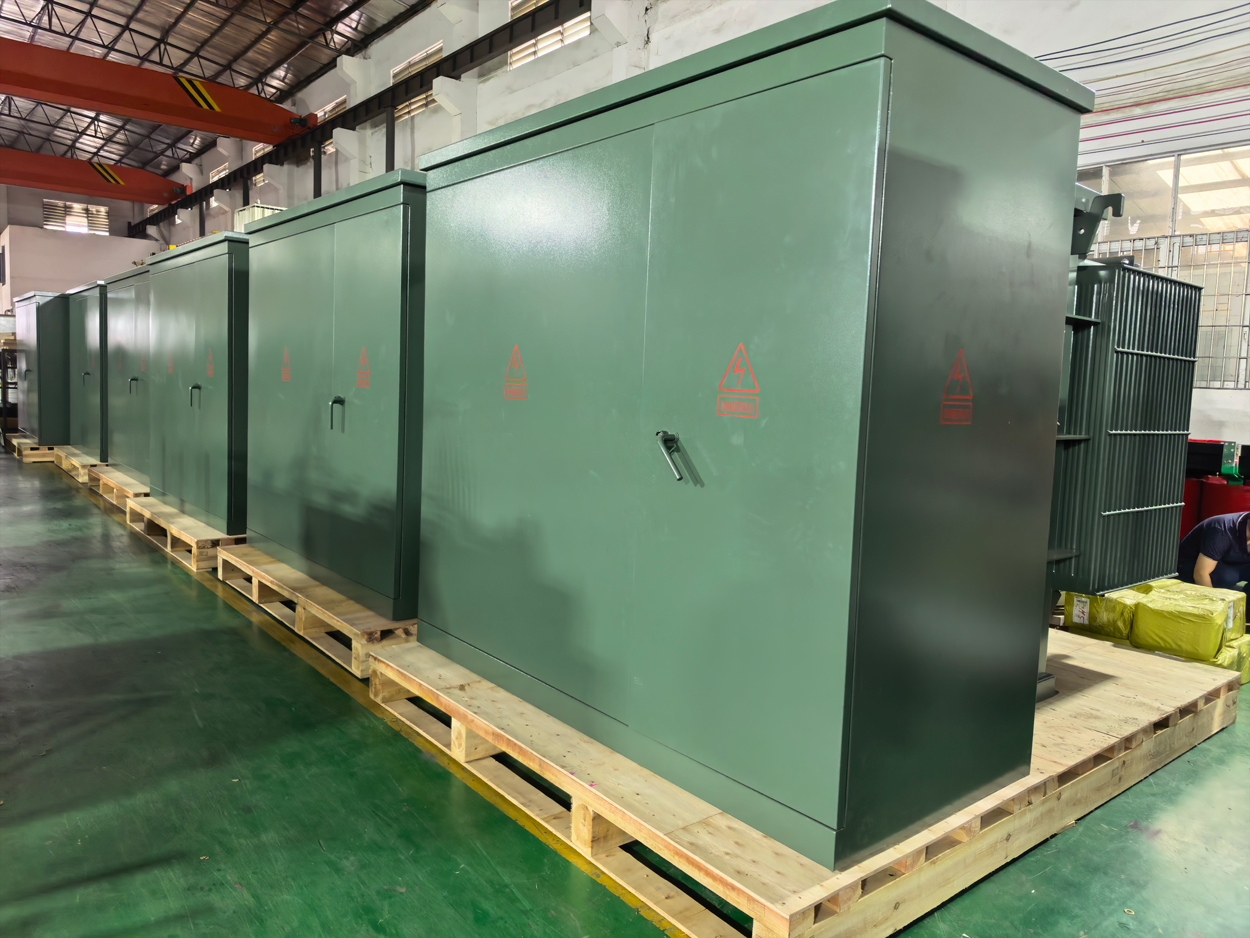
One completed project in the United States involved 31 units of three-phase pad mounted transformers delivered to an electricity utility company. The batch covered two core specifications: 2550 kVA and 3750 kVA, with high-voltage ratings of 34.5 kV and 12.87 kV. The transformers are UL/cUL listed, comply with ANSI/IEEE standards and DOE 2016 energy conservation requirements, and were delivered on time. That batch demonstrates the difference between ordering a single transformer and managing a repeatable ODM process for a multi-site program.
FAQ
1. Are Winley Electric pad-mounted transformers UL/cUL listed and ANSI/IEEE compliant?
Yes. The three-phase pad-mounted transformer line is UL and cUL listed under certificate E536138, covering rated capacities from 45 kVA to 5000 kVA and high voltage up to 36 kV. The single-phase line is also UL/cUL listed under E536138 for 10 to 250 kVA. The designs follow the relevant ANSI/IEEE C57 standards for pad-mounted transformers and CSA C227 requirements where applicable. For an EPC, this means the units can be specified for U.S. and Canadian utility projects without a separate qualification process.
2. What can be customized in an ODM pad-mounted transformer order?
Electrical performance, structure and appearance, insulation fluid, protection devices, switches, gauges, tank coating, and extreme environment adaptations can all be customized. Winley Electric supports OEM/ODM production up to 10 MVA and 36 kV, and can integrate monitoring, protection, and communication interfaces per customer drawings. Specialized components from known suppliers such as Qualitrol and Eaton Cooper can be included when the application requires them.
3. How does customization affect budget?
Cost is driven by material choices and specification depth. According to a transformer buyer guide, FOB prices for pad-mounted transformers from China in 2025 typically ranged from USD 25 to USD 70 per kVA depending on materials. For a project-specific number, an EPC should send the electrical specification and enclosure requirements early. The incremental cost of customization is often small compared with the cost of correcting a mismatch during field installation.
4. Can we order a small batch or single unit before full project release?
Yes. The minimum order quantity is one unit. This allows an EPC to build a pilot unit, conduct factory routine tests and type tests according to customer requirements, inspect the actual protection configuration, and then release the full batch after the design is confirmed.
5. What lead time should an EPC plan for an ODM pad-mounted transformer order?
Typical production lead time is 4 to 8 weeks. With a monthly production capacity of 500 units, the manufacturer can handle batch programs such as the U.S. utility project where 31 units of 2550 kVA and 3750 kVA three-phase pad-mounted transformers were delivered on time. For a specific project date, send the specification and required delivery window; Winley Electric can review feasibility against current production capacity.
Conclusion: Make Drawings, Protection, and Testing Part of the Order
Field rework is avoidable when the pad-mounted transformer is treated as an engineered product rather than a catalog item. An EPC should define the electrical specification, approve ODM drawings, confirm protection class, agree on factory tests, and align batch delivery with project milestones. Winley Electric provides full ODM customization up to 10 MVA and 36 kV, with UL/cUL certification, a minimum order quantity of one unit, a typical lead time of 4 to 8 weeks, and a 24-month warranty from bill of lading.
Click to view more pad‑mounted transformer projects from Winley Electric:https://www.winley-electric.com/supplier-4701740-three-phase-pad-mounted-transformer
Start with a Drawing Review
Send your project specification, feeder arrangement, and site protection requirements to Winley Electric for an ODM feasibility review.
Email: steven@winley-electric.com
WhatsApp: +86 18650108051
Website: www.winley-electric.com

Have Questions or Need More Details?
Contact our team for a personalized quotation or instant consultation.
Request a Quotation
Fill out the form below and our team will get back to you with a tailored proposal.
WhatsApp Direct Chat
Prefer to chat in real-time? Message us on WhatsApp for instant assistance & quick answers.
- Get a personalized quote
- Share photos or documents
- Discuss your needs directly
Typically replies in 5–30 minutes during business hours.