Single-Phase vs Three-Phase Pad Mounted Transformers: A Cost Comparison
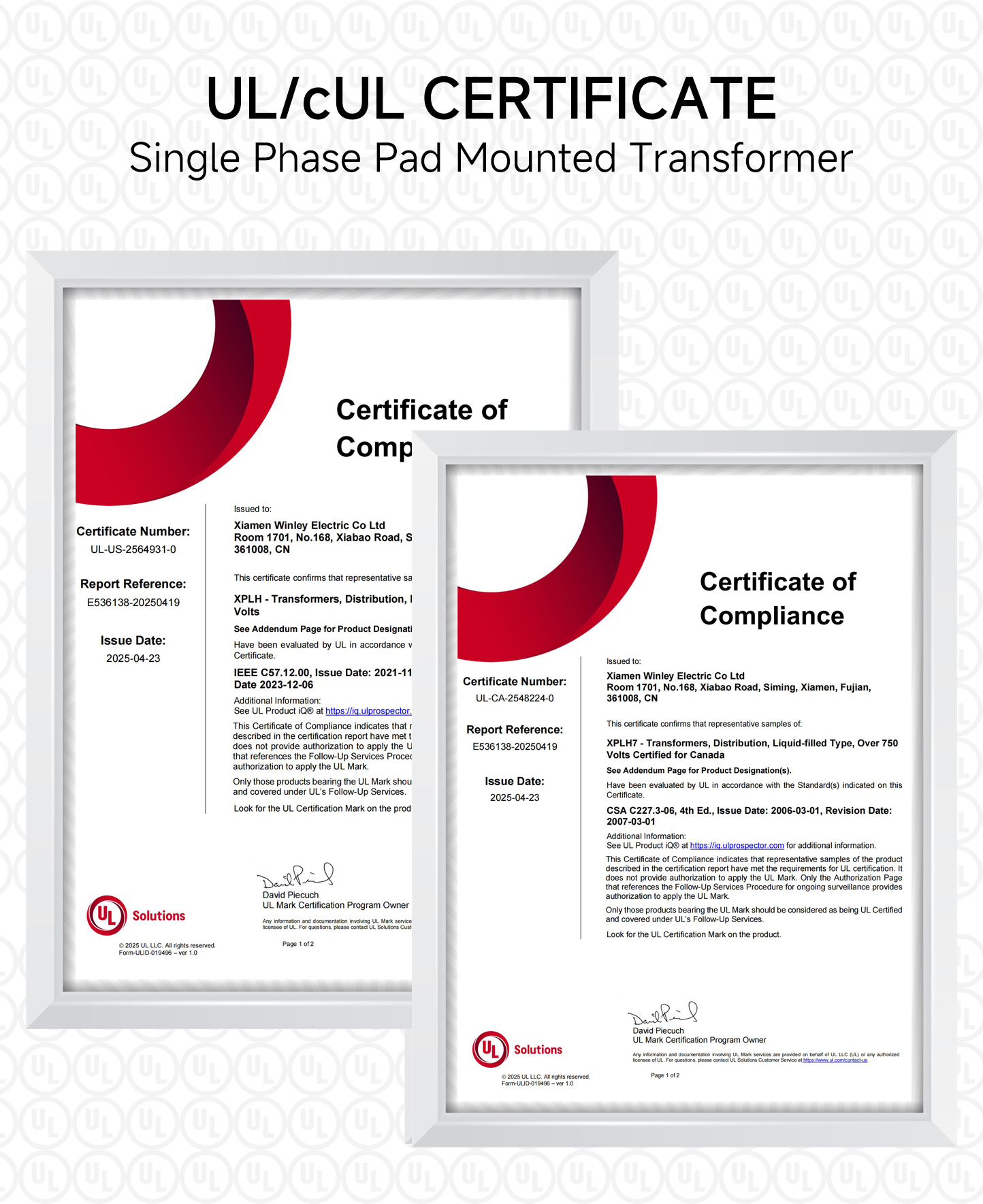
Single-phase pad-mounted transformers carrying UL and cUL certification. Source: Winley Electric.
A three-phase pad mounted transformer is the default for a North American commercial site that carries three-phase loads or requires a service beyond small single-phase demand. A single-phase pad mounted transformer is the lower-scope option for a discrete single-phase load. The cost comparison between the two is only accurate when it covers five layers: the transformer itself, compliance documentation, interconnection requirements, installation and civil works, and schedule.
This comparison is written for buyers at the decision stage — facility owners, EPCs and procurement teams budgeting custom pad-mounted units for small and mid-size commercial projects, including campus EV charging builds. It sets out the technical difference that drives cost, a five-layer budget model, a step-by-step sequence for one specific project, and the points where customization changes the long-term number rather than the day-one price.
Company-specific figures in this article are attributed to the manufacturer that reports them and identified as company-reported. Market figures come from Market Research Future's 2026 US pad-mounted transformer report, and the standards reference is IEEE C57.12.34-2022. Where the supplied evidence does not cover a value, the text says so instead of estimating it.
Why this comparison is a budget decision, not a preference
The choice between a single-phase and a three-phase pad mounted transformer fixes six things at once: the service the utility will connect, the winding and connection arrangement on the nameplate, the number and size of secondary conductors, the protection and fusing arrangement, the pad footprint and clearances, and the approval path through interconnection review.
Two consequences follow for the budget. First, the phase decision has to be settled before the manufacturer freezes drawings, because it changes the design rather than selecting an option from a price list. Second, a phase error is not recovered by a discount. If a site is engineered for three-phase service and a single-phase unit is ordered, the secondary distribution, protection coordination and utility interconnection all need rework, and the schedule absorbs the re-approval as well as the replacement.
That is why the useful comparison is not 'which transformer costs less' but 'which configuration keeps the whole project inside one design cycle'.
The technical difference that drives every cost line
Service configuration and load compatibility
A single-phase pad mounted transformer takes one phase and a neutral from the primary system and delivers a single-phase secondary. A three-phase unit takes all three phases and delivers a three-phase secondary, connected in wye or delta according to the project's distribution design. Compartmental, self-cooled, oil-immersed construction is common to both configurations in North American pad-mounted distribution; the difference sits in the winding and termination arrangement.
Load compatibility settles most projects on its own. Three-phase motors, commercial HVAC compressors, rectifier-front-end DC fast chargers and three-phase solar inverters cannot be served from a single-phase secondary. Lighting, receptacles, signage, gate operators and single-phase Level 2 charge points are single-phase loads — but a group of them still has to be spread across phases to keep the service balanced, which normally means a three-phase service feeding single-phase branch circuits.
Capacity: what the documentation actually states
Winley Electric manufactures both single-phase and three-phase pad-mounted transformers. The verified capacity range in the evidence used for this comparison — 75 kVA to 5,000 kVA — is stated for three-phase units. No equivalent verified range is supplied for single-phase models, so a single-phase rating has to come from the datasheet of the specific model being quoted rather than being inferred from the three-phase range. Buyers weighing a small single-phase option against a three-phase unit should request both datasheets and compare nameplate values side by side before the drawing freeze.
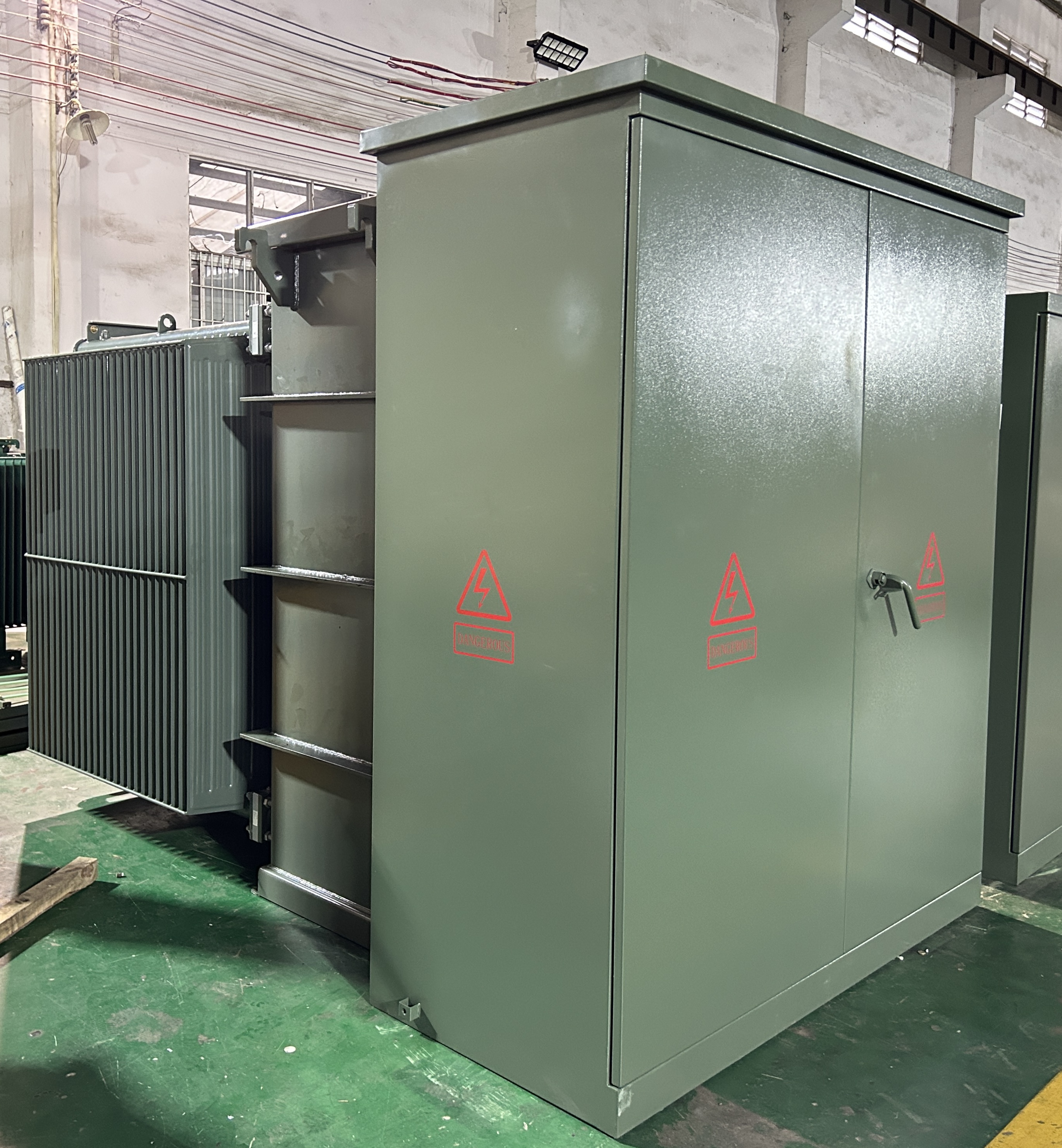
Three-phase oil-immersed pad mounted transformer, 1500 kVA, 34,500 V to 208 V. Source: Winley Electric.
Conductors, protection and footprint
Current per conductor is the practical difference. For the same power, a three-phase service divides the load across three conductors, so each carries less current than the single-phase equivalent; that generally reduces secondary conductor size and count for a given load. A three-phase unit also carries three high-voltage terminations and a corresponding switching and fusing arrangement, where a single-phase unit carries one.
Footprint and continuity pull in opposite directions. One three-phase unit is generally more compact than the equivalent bank of single-phase units, but it is a single point of supply. A bank of single-phase transformers can keep part of a site energized when one unit is out of service, at the cost of more pads, more terminations, more cable and a wider spare-parts list.
Industry background: why schedule became a budget line
The US pad-mounted transformer market was estimated at USD 3,750.0 million in 2024 and projected to reach USD 8,320.0 million by 2035 in Market Research Future's 2026 report. Those are commercial-research estimates rather than utility order books, but they describe the direction of the procurement problem: demand has grown faster than the manufacturing capacity serving it, and small and mid-size commercial projects compete for the same production slots as larger programmes.
Two standards anchor the specification. IEEE C57.12.34-2022 is the current IEEE standard for pad-mounted, compartmental-type, self-cooled three-phase distribution transformers rated 10 MVA and smaller. UL 1561 is the listing scope against which Winley Electric's certification is reported, alongside IEEE C57.12.34 and DOE 2016 efficiency requirements.
Lead time belongs in the same budget as the hardware. Winley reports 4–6 week manufacturing lead times for its pad-mounted units against 20–40 weeks for North American local manufacturers. That is a company-reported comparison and should be confirmed in writing against the specific project schedule rather than assumed. For a project with a fixed energization date, a shorter manufacturing window converts directly into fewer weeks of site cost, storage and contingency.
A five-layer budget model for single-phase and three-phase options
Unit price is rarely the largest item on a small or mid-size project, because four other layers move with the phase choice. Building the budget in this order makes the comparison between options readable at a glance.
- Transformer scope. kVA rating, primary and secondary voltage, wye or delta connection, impedance, taps, fusing, enclosure and accessory package. A single-phase unit removes two high-voltage terminations and their switching hardware from the scope; a three-phase unit removes the need for several single-phase units, their pads and their interconnections.
- Compliance and documentation. Listing scope, type-test evidence such as lightning impulse reports, routine test reports and approved drawings. Budget the engineering time to review that package, not only the certificate itself.
- Interconnection. The utility's available primary voltage and phase, protection coordination and the approval sequence. This is the layer where a late phase decision costs most, because it can restart the review.
- Installation and civil works. Pad, conduit, secondary conductors, terminations and the labour to land them. Conductor count and size differ between the two configurations, so the electrical contractor's number should be priced against the actual single-line diagram.
- Schedule. Manufacturing weeks, freight, storage, commissioning and any contractual delay exposure. On a project carrying liquidated damages, this layer can outweigh the first four.
Present a bid comparison in that order, and a modest difference in unit price becomes visibly smaller than a ten-week difference in delivery.
Step-by-step: building the comparison for one project
1. Separate the loads. Split the load schedule into three-phase and single-phase loads, and record the largest single-phase load. This one step decides most projects.
2. Confirm the available service with the utility. Primary voltage, phase availability and interconnection requirements should be documented before the transformer design is fixed. A design that assumes a service the utility will not provide is a redesign, not a negotiation.
3. Choose the phase from the dominant load, not the total. A site with a modest total load but one three-phase chiller is a three-phase project. A remote lot with lighting, signage and no three-phase equipment is a genuine candidate for a single-phase unit.
4. Fix the voltage ratio and connection. The nameplate must match the utility's primary voltage and the site's secondary distribution, including the wye or delta arrangement. Documented examples in Winley's three-phase range include units rated 34,500 V to 480Y/277 V and 12,470 V delta to 480Y/277 V. The correct value is always the project's, never the closest catalogue entry.
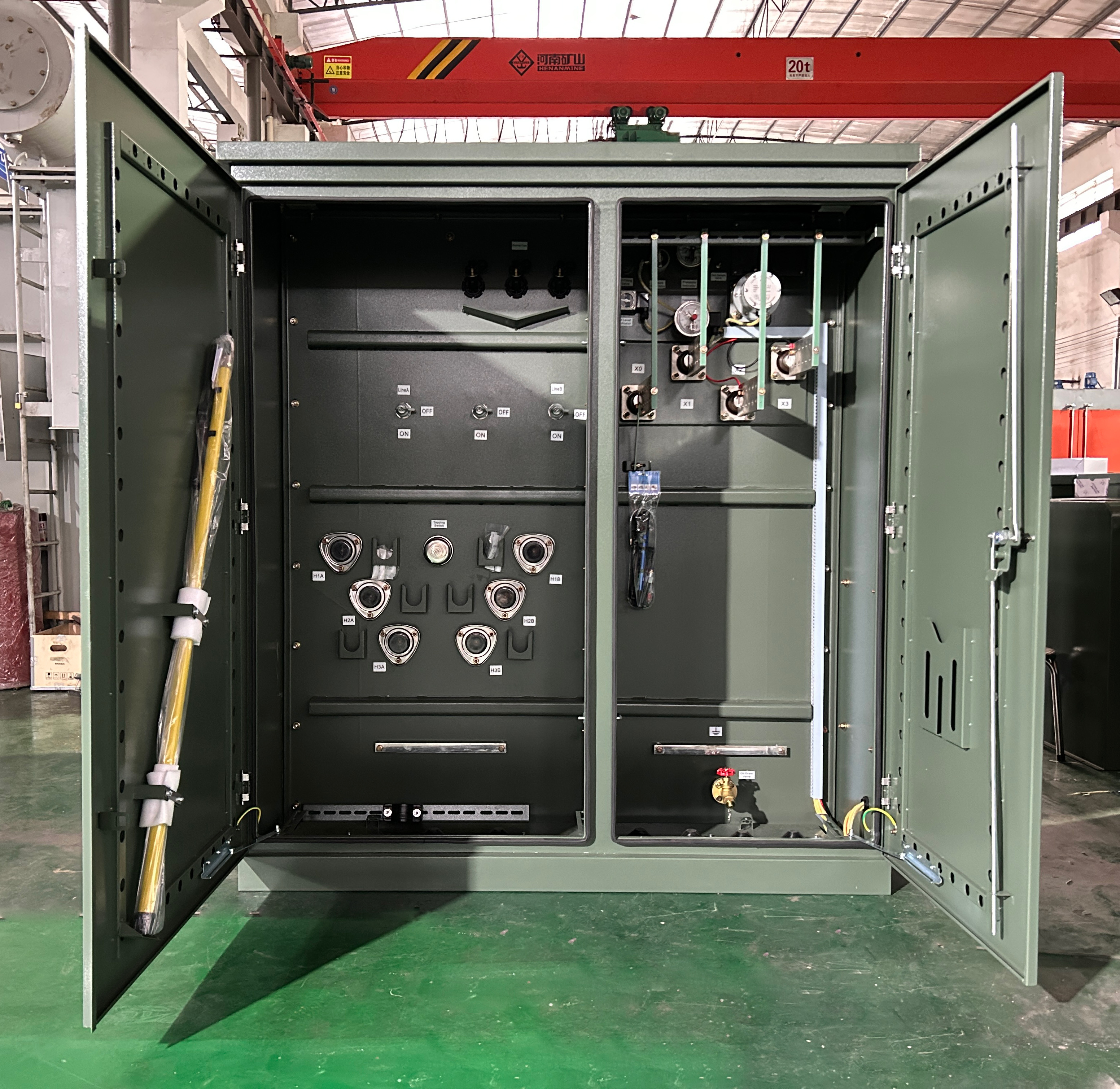
5 MVA three-phase pad mounted transformer, 13,800 V to 4,160Y/2,400 V, built to ANSI/IEEE standards. Source: Winley Electric.
5. Specify impedance, fusing and accessories against the protection study. These items are frequently left at a default and then changed after the coordination study, which reopens the drawing set and the quotation.
6. Fix the standard and the evidence package. For a three-phase unit, IEEE C57.12.34-2022 applies. Confirm the listing scope, the routine test report and the DOE 2016 efficiency position in the quotation, not after delivery.
7. Freeze drawings, then lock schedule and freight. Keep the drawing approval, the factory test report and the shipping documents as one package, so a later phase of the same campus can reuse the configuration without a second design cycle.
Each of these steps is cheaper to revise on paper than in production. That is why the sequence matters more than the individual choices inside it.
Campus EV charging: mapping charger types to transformer phase
A campus charging build usually mixes load types, which makes it a useful test case for the single-phase versus three-phase decision.
If the charger mix is entirely single-phase Level 2 equipment, the transformer decision still usually lands on three-phase: the charge points have to be distributed across phases to avoid an unbalanced service, and the buildings sharing the campus add three-phase loads. The genuine single-phase case is a remote, small load — a lighting circuit, signage or a gate — far from the main service, where a small single-phase pad-mounted unit avoids extending a three-phase feeder to a low-demand location.
If the campus includes DC fast charging, the rectifier front end is a three-phase load, so the service must be three-phase and the comparison shifts from phase selection to capacity allocation: how much of the transformer is reserved for the fast-charging block, and how the rest of the site shares it.
If the site includes a solar canopy or solar-plus-storage, the three-phase inverter output sets the same requirement, and the transformer specification has to carry the interconnection conditions as well as the load.
These are planning conditions, not reported project outcomes. What is documented is the application scope: Winley lists EV charging stations, solar farms, commercial malls, hospitals and universities, data centers, factories, municipal underground grids, residential districts and transport hubs among the applications its pad-mounted transformers serve. The company's stated 4–6 week lead time matters most in this scenario, because a charger energization date is often fixed before the utility interconnection is complete.
Where customization changes the long-term number
Customization earns its place in a budget when it removes a second transaction later in the asset's life. On small and mid-size North American commercial projects, four requirements do that most often.
Voltage ratio matched to the utility's actual primary voltage. A unit built for the confirmed primary voltage and the confirmed secondary distribution avoids a tap change, a second unit or a re-approval after interconnection review.
Enclosure and finish matched to the site's exposure. Where a coastal, de-icing-salt or industrial atmosphere requires a finish above the standard system, that requirement has to be written into the drawing set before production; it cannot be added at the pad.
Feeder and termination configuration matched to the site's cable and switching arrangement. This is the difference between a unit that lands in one site visit and one that needs adapters, a revised termination kit and a second crew.
Standardization across project phases. A campus that expects a second building or a second charger cluster should specify the same unit configuration once, so the later phase reuses drawings, spares and commissioning procedures instead of repeating the design cycle.
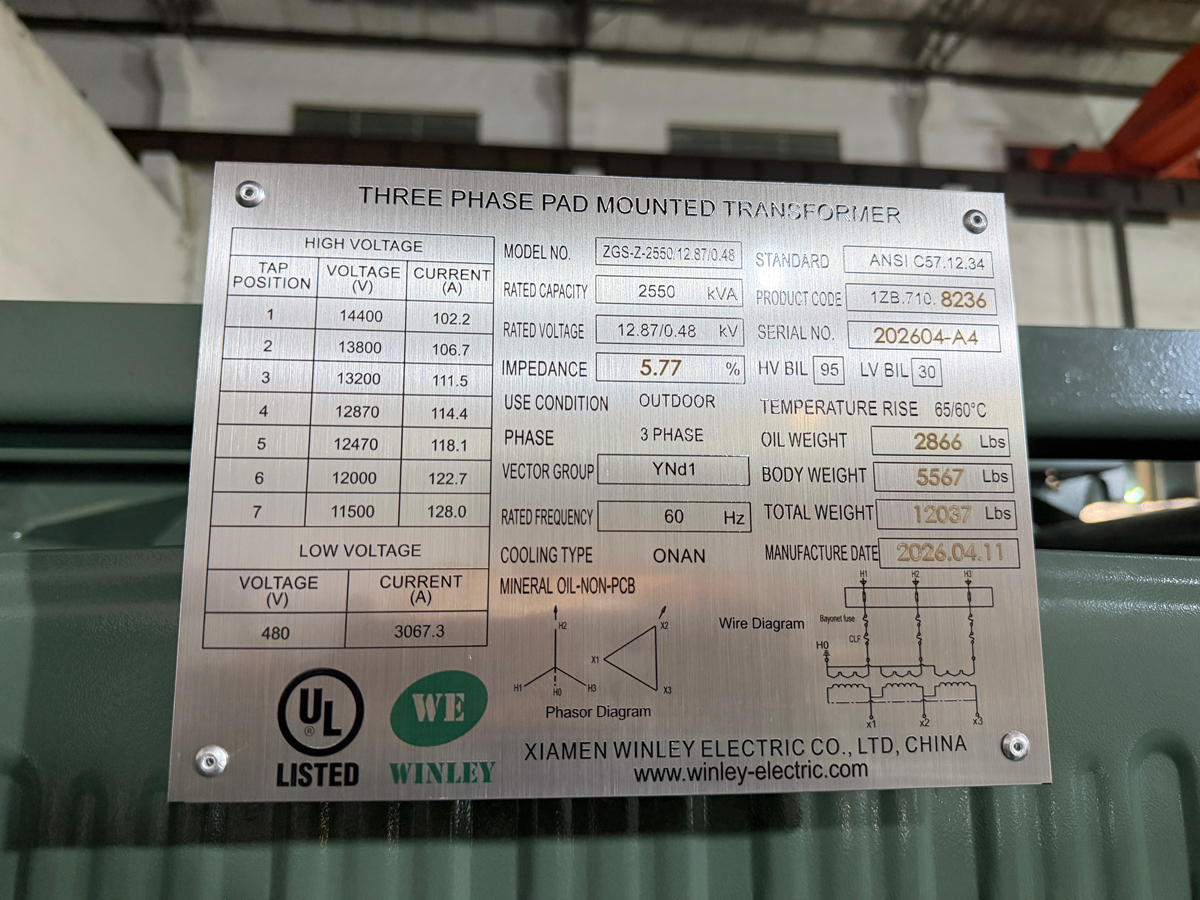
2550 kVA three-phase pad-mounted transformer in factory testing. Source: Winley Electric.
Two support items also enter the long-term number. Winley states a 2-year free maintenance service and 24/7 technical support. Its production control uses mandatory hold points at defined stages, where authorized quality personnel must inspect and sign off before the process continues — a control that matters when the buyer's only other review opportunity is the factory acceptance test.
The long-term case for customization should not be presented as a measured saving. It is a reduction in the number of design changes, adapters and one-off spares a project has to carry over its life — a claim a buyer can verify against their own change orders rather than against a supplier's projection.
Single-phase vs three-phase: side-by-side comparison
| Comparison dimension | Single-phase pad mounted transformer | Three-phase pad mounted transformer |
|---|---|---|
| Primary service | One phase and neutral | All three phases |
| Typical loads | Lighting, receptacles, signage, gate operators, single-phase Level 2 charge points, small remote loads | Three-phase motors, commercial HVAC, DC fast charging, three-phase inverters, mixed campus load |
| Documented capacity range | Not stated in this evidence set; take the value from the specific model datasheet | 75 kVA to 5,000 kVA (Winley Electric documentation) |
| Secondary conductors | Fewer conductors, higher current per conductor for the same power | Load divided across three conductors |
| Footprint | Several units and pads for the same total capacity | One unit for the same capacity, with a larger single footprint |
| Continuity of supply | Part of the site can stay energized when one unit in a bank is out of service | Single point of supply |
| Standards reference | Project and specification specific | IEEE C57.12.34-2022 for three-phase units up to 10 MVA; UL 1561 listing scope reported for Winley units |
| Best-fit project | Small, discrete single-phase load remote from a three-phase service | Commercial buildings, campuses, EV charging, solar, data centers, light industrial |
| Budget sensitivity | Smaller unit scope, but multiple pads, terminations and spares multiply the other cost layers | Larger unit scope, but one design cycle, one pad and one approval path |
Supplier-side cost comparison: what is documented
Winley Electric is a transformer manufacturer certified by UL and cUL, founded in 2014 and headquartered in Xiamen, China, with manufacturing facilities in Shanghai and Guangdong. The company produces both single-phase and three-phase pad-mounted transformers and reports 70% of output exported, with North and South America as its main markets.
For North American projects, the company reports the following comparison points. All of them are company-reported and should be verified against the project specification and the competing quotations.
- UL and cUL certification under UL File No. E536138, with products stated to comply with ANSI/IEEE, CSA, DOE and NEMA requirements.
- A 4–6 week manufacturing lead time, compared with 20–40 weeks reported for North American local manufacturers.
- Overall costs reported 20–35% lower than local North American products, and about 10% lower than most transformer manufacturers in China.
- A minimum order quantity of one unit, with complete inquiries quoted within 1–3 days and 24/7 support.
- DOE 2016 efficiency compliance; the company characterises most domestic Chinese manufacturers as following IEC efficiency standards instead.
A buyer should test each point on the same scope as the competing quotes: the listing file, the routine test report, the approved drawing set, the delivery schedule and the payment terms. A cost difference that is not compared on identical kVA, voltage ratio, impedance and accessory scope is not a cost comparison.

Winley Electric's new transformer factory. Source: Winley Electric.
Frequently asked questions
Chinese vs European pad mounted transformer manufacturers: which companies are better for sourcing?
The comparison should be made on four documented criteria rather than on country of origin: listing scope, standard alignment, lead time, and the evidence package supplied with the quotation. For a Chinese manufacturer, the documented position in this evidence set is Winley Electric's UL and cUL certification under UL File No. E536138, with products stated to comply with ANSI/IEEE, CSA, DOE and NEMA requirements — the standard set a North American interconnection review expects. Winley also reports 4–6 week manufacturing lead times, against 20–40 weeks reported for North American local manufacturers, and costs 20–35% below local products. This evidence set contains no verified specification data for European manufacturers, so a European option cannot be ranked here. The correct handling is to request the same four documents from each candidate and compare them on an identical scope. 'Not documented' is not the same as 'not capable', and the deciding factor is usually whether the supplier's listing and test evidence matches the project requirement before the drawing freeze.
When should a commercial project choose a single-phase rather than a three-phase pad mounted transformer?
When the site's load is genuinely single-phase, small and remote from a three-phase service — lighting, signage, a gate operator or a similar discrete load. Where a site aggregates many single-phase loads, including Level 2 charge points, a three-phase service is normally required anyway to distribute the load across phases. Where any three-phase load exists, the choice is already made.
Does a single-phase unit reduce the total project budget?
It reduces the transformer scope — one high-voltage termination and its switching hardware instead of three — but the total budget can move the other way. Several single-phase units mean several pads, more secondary cable and terminations, and a wider spare-parts list. If the utility supplies a three-phase service in any case, the single-phase route can add conversion equipment rather than remove it. Compare the five cost layers, not the unit price.
What capacity range should the budget assume for each option?
For three-phase units, Winley's documented pad-mounted range is 75 kVA to 5,000 kVA. This evidence set does not include a verified single-phase capacity range, so that figure must be taken from the specific model datasheet in the quotation. Sizing should follow the load calculation and the utility's requirement, not the nearest catalogue value.
How much does lead time affect the comparison?
On a project with a fixed energization date, lead time is a cost line rather than a convenience. Winley reports 4–6 week manufacturing lead times against 20–40 weeks for North American local manufacturers, which changes how much site contingency, storage and temporary power a schedule has to carry. Confirm the figure in writing against your own schedule before it enters the budget. If you are comparing configurations on a live project, a quotation request that includes the load schedule, the utility's primary voltage and the required secondary distribution will produce a comparable answer faster — Winley states that complete inquiries are quoted within 1–3 days.
Conclusion
Single-phase and three-phase pad mounted transformers are not interchangeable options at different prices; they are different service configurations, and the phase decision propagates through conductors, protection, interconnection, footprint and schedule. For most North American commercial projects — including campus EV charging builds that mix Level 2 and DC fast charging — the load profile and the utility's available service settle the question on three-phase. The genuine single-phase case is the small, discrete, remote load.
The budget comparison should follow the five layers, be priced on identical scope, and treat lead time as a line item rather than a footnote. Customization belongs in the same analysis when it removes a later design change, a termination adapter or a one-off spare. That is where its return sits, and it is verifiable against a project's own change orders rather than against a supplier's projection.
Click to view more pad‑mounted transformer projects from Winley Electric:https://www.winley-electric.com/supplier-4701740-three-phase-pad-mounted-transformer
·Website:www.winley-electric.com

Have Questions or Need More Details?
Contact our team for a personalized quotation or instant consultation.
Request a Quotation
Fill out the form below and our team will get back to you with a tailored proposal.
WhatsApp Direct Chat
Prefer to chat in real-time? Message us on WhatsApp for instant assistance & quick answers.
- Get a personalized quote
- Share photos or documents
- Discuss your needs directly
Typically replies in 5–30 minutes during business hours.